Safest starting advice
If this is your first serious entry into fuse beads, 5mm is usually friendlier. Choose 2.6mm when you already have steadier placement control and want to trade convenience for finer detail.
- 5mm gives beginners more placement and ironing tolerance.
- 2.6mm can hold finer detail but asks more from your hands, tools, and heat control.
- Smaller is not automatically better. It is just a different tradeoff.
The most direct difference between the two sizes
5mm beads are easier to pick up, place, inspect, and read while melting. That makes them much more forgiving for beginners learning the full workflow.
2.6mm beads support denser detail in a smaller footprint, but they shift more easily, demand finer handling, and leave less room for heat-control mistakes.
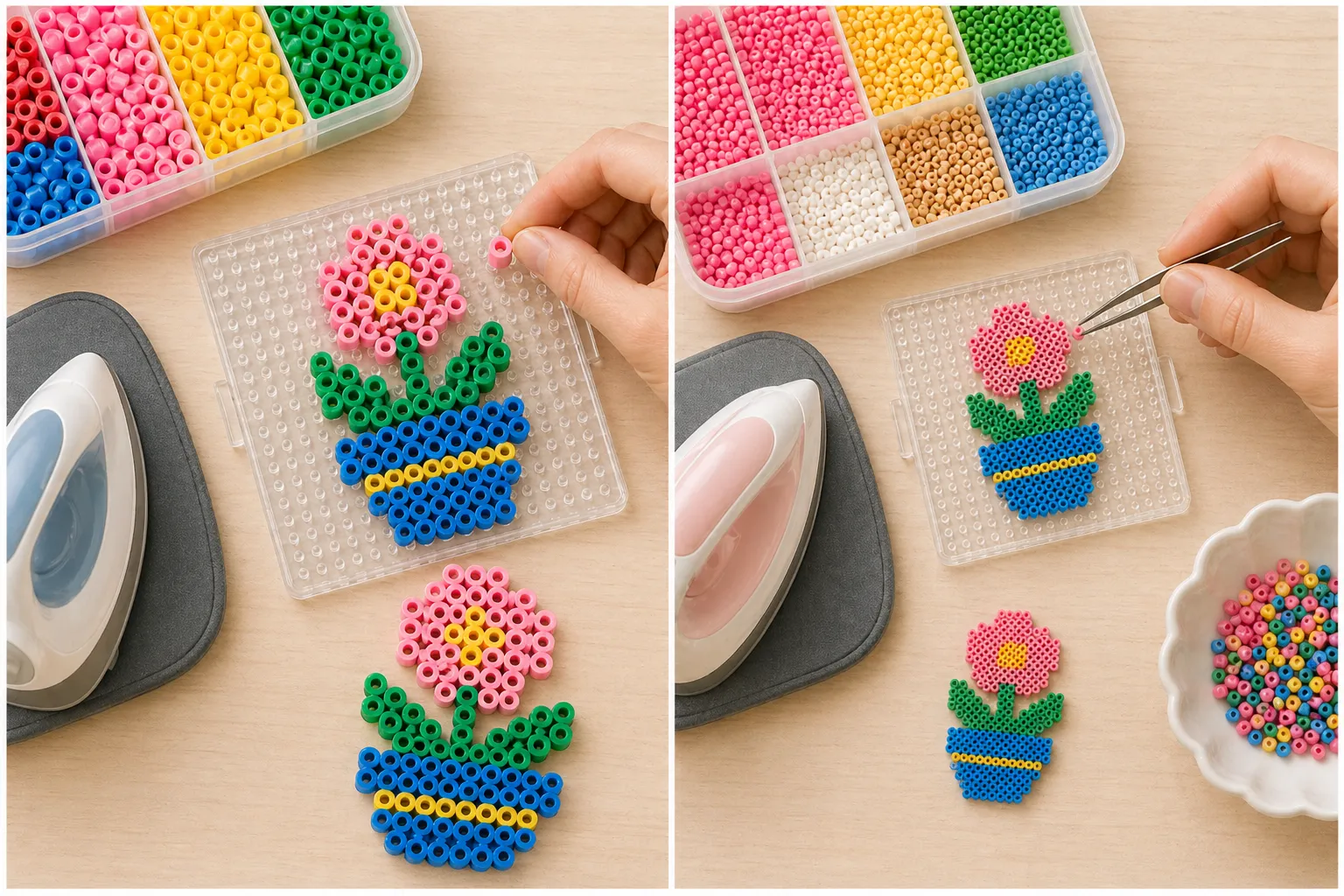
Which projects fit each size better
- Choose 5mm for first projects, charms, and learning the full process.
- Choose 2.6mm if you want tighter pixel detail in a smaller finished piece.
- 5mm is usually easier for larger work. 2.6mm shines more on compact detailed pieces.
What size changes in your tool setup
Smaller beads raise the bar for tweezers, board precision, lighting, desk stability, and iron control. Many 2.6mm failures are not about pattern difficulty so much as trying to use a 5mm-style workflow on a much smaller scale.
If you are already unsure about irons, barrier materials, and large-piece methods, that usually means you will benefit from stabilizing your 5mm process before shrinking the bead size.
The lowest-friction way for beginners to decide
The easiest route is often to learn the full pattern-placement-ironing-flattening loop with 5mm first, then test 2.6mm on a small sample once you know the look you want.
That helps you distinguish between genuinely preferring the smaller format and simply being attracted to how intricate it looks.