Short answer
The best first fuse bead projects are small charms, small characters, simple animal faces, and straightforward coasters with clear outlines and limited colors. The worst first choices are large portraits, complex full-body characters, long thin weapons, and gradient-heavy designs with fragile edges.
- Your first project should help you complete the whole workflow, not prove your maximum skill.
- Clear outlines, fewer colors, and moderate size give beginners much more room to succeed.
- Charms, small characters, and simple coasters teach placement and ironing with less punishment.
- Projects with lots of thin protrusions or near-matching colors are poor first choices.
Ask what is most likely to succeed first, not what looks coolest
Your first project should build process confidence: reading a pattern, placing beads, moving the board, ironing, flattening, and finishing. If the subject is too difficult, you will not know whether the problem is your technique or the project itself.
That means the right first-project question is not “what do I love most?” but “what can I finish cleanly enough to learn the whole workflow and still feel motivated afterward?”
- Choose something you can finish in one focused session or a small number of sessions.
- Choose a structure that will not collapse the first time you move it.
- Choose a design that can survive ironing without losing its identity.
Four project types that work especially well for beginners
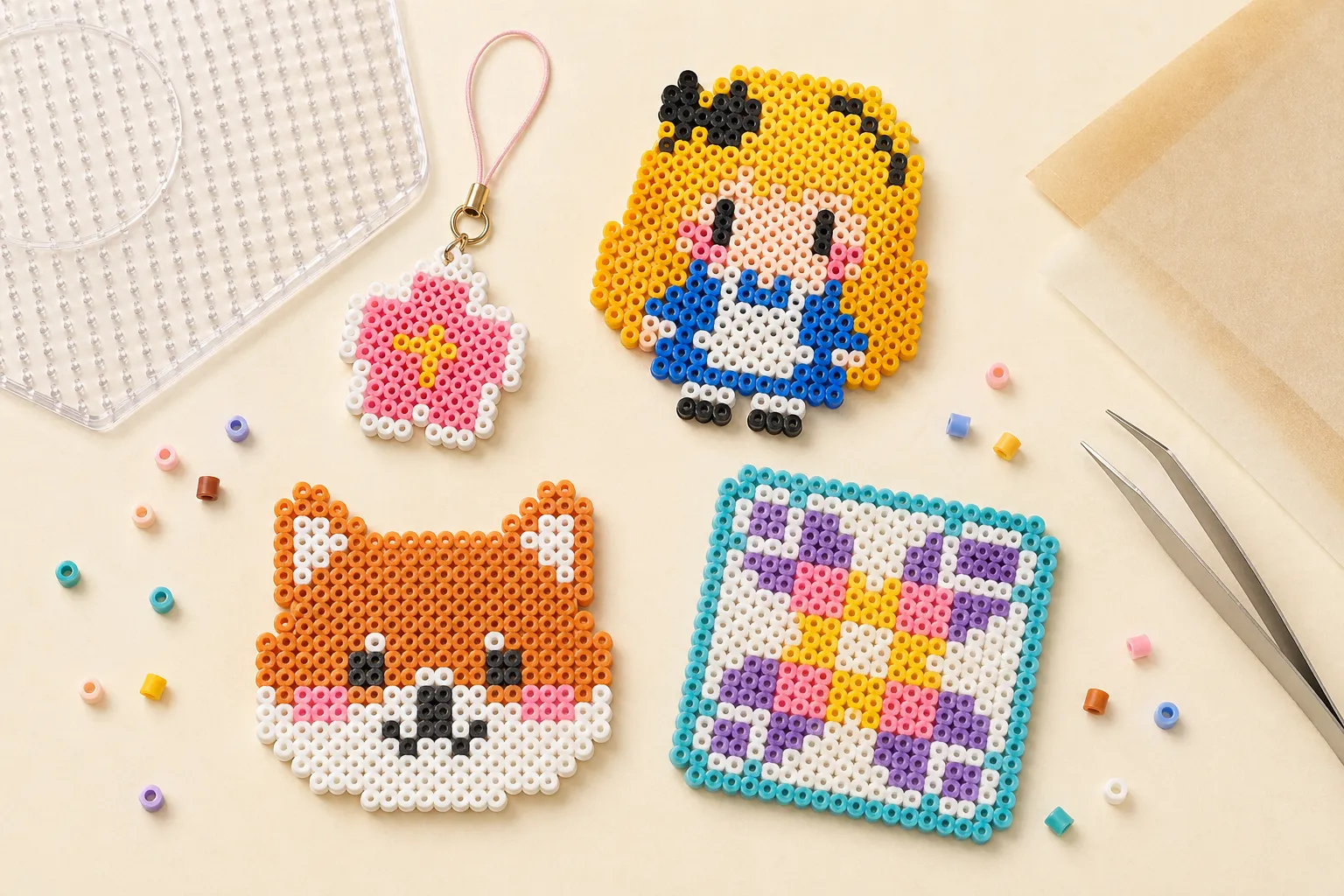
The friendliest first category is small charms and badges. They are compact, structurally complete, and give a strong sense of finishing a real object.
The second category is small characters with controlled detail. The third is simple animal faces or expressive icon-like designs that stay readable after simplification. The fourth is a simple coaster, which is useful for practicing even coverage and edge control.
- Small charms: short workflow and quick sense of progress.
- Small characters: a better entry point if you want people or sprites without a huge challenge spike.
- Simple animals or expressions: clear shapes and high readability.
- Coasters: great for practicing even melt coverage on stable shapes.
Why these project types are better for a first win
They are not better because they are childish or basic. They are better because the structure is complete, the color logic is easier to track, and tiny details do not control the entire success of the piece.
That matters because beginners need feedback that says “I can do this.” Once you complete one project successfully, learning size decisions, palette trimming, and finishing style becomes much easier.
- Complete silhouettes survive flipping and moving better than fragmented edges.
- Fewer colors usually mean fewer placement mistakes.
- Lower detail density makes the design more resistant to blur while ironing.
- Moderate size makes heat distribution easier to judge.
What beginners should not pick first
The roughest first choices are detailed front-facing portraits, gradient-heavy character art, large full-body sprites, designs with long weapons or wings, and oversized work that depends on lots of tiny details.
Another common trap is choosing the design you are emotionally most attached to, then refusing to simplify it. That usually leaves the first project stuck at a difficulty level that fights the beginner workflow at every step.
- Detailed portraits: facial features and hair detail blur easily.
- Large character poses: more area, more weak points, more heat-management pressure.
- Weapons, wings, tails, and thin extensions: much higher handling risk.
- Strong gradients and many similar colors: tiring to place and expensive to fix.
FAQ
Does my first project have to be very small?
Not necessarily tiny, but it should be small enough that you can finish it without the project becoming a marathon. The main goal is controlled complexity, not minimum size.
Is a charm or a coaster better for a beginner?
A charm is usually better if you want a quick win and strong completion feeling. A simple coaster is also excellent if you want to practice steadier large-area ironing.
Can my first project still be a character?
Yes, but it should be a smaller character with limited colors and a strong silhouette, not a detailed portrait or a large full-body figure.
Why is my favorite complicated design a bad first choice?
Because you will usually resist simplifying it, which means the first project becomes a fight against fragile structure, dense detail, and harder ironing all at once.