先に結論
最初に向くのは、小さなチャーム、小さなキャラ、シンプルな動物の顔、コースターのように、輪郭がはっきりして色数が少なく、構造が安定した題材です。
- 最初の一作は難しさより、最後まで作り切れるかを優先する。
- 輪郭がわかりやすく色が少ない題材は、配置とアイロンの練習に向いている。
- チャーム、小キャラ、シンプルなコースターは始めやすい。
- 細長い突起や似た色が多い図は、最初の一作に向きにくい。
いちばん映える図より、いちばん成功しやすい図を選ぶ
Your first project should build process confidence: reading a pattern, placing beads, moving the board, ironing, flattening, and finishing. If the subject is too difficult, you will not know whether the problem is your technique or the project itself.
That means the right first-project question is not “what do I love most?” but “what can I finish cleanly enough to learn the whole workflow and still feel motivated afterward?”
- Choose something you can finish in one focused session or a small number of sessions.
- Choose a structure that will not collapse the first time you move it.
- Choose a design that can survive ironing without losing its identity.
最初の一作に向く 4 つの題材
The friendliest first category is small charms and badges. They are compact, structurally complete, and give a strong sense of finishing a real object.
The second category is small characters with controlled detail. The third is simple animal faces or expressive icon-like designs that stay readable after simplification. The fourth is a simple coaster, which is useful for practicing even coverage and edge control.
- Small charms: short workflow and quick sense of progress.
- Small characters: a better entry point if you want people or sprites without a huge challenge spike.
- Simple animals or expressions: clear shapes and high readability.
- Coasters: great for practicing even melt coverage on stable shapes.
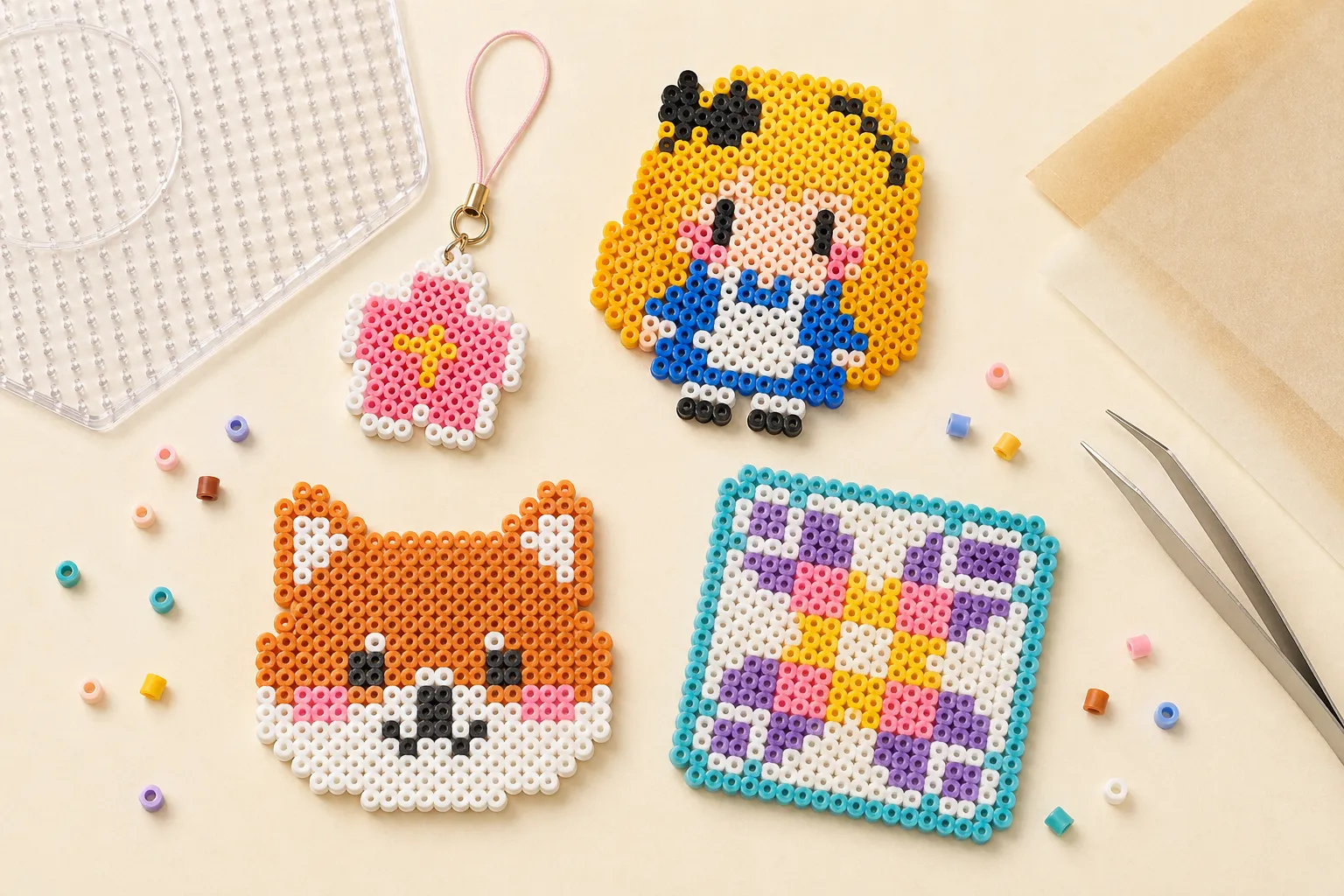
なぜこの題材が作りやすいのか
They are not better because they are childish or basic. They are better because the structure is complete, the color logic is easier to track, and tiny details do not control the entire success of the piece.
That matters because beginners need feedback that says “I can do this.” Once you complete one project successfully, learning size decisions, palette trimming, and finishing style becomes much easier.
- Complete silhouettes survive flipping and moving better than fragmented edges.
- Fewer colors usually mean fewer placement mistakes.
- Lower detail density makes the design more resistant to blur while ironing.
- Moderate size makes heat distribution easier to judge.
最初に避けたい題材
The roughest first choices are detailed front-facing portraits, gradient-heavy character art, large full-body sprites, designs with long weapons or wings, and oversized work that depends on lots of tiny details.
Another common trap is choosing the design you are emotionally most attached to, then refusing to simplify it. That usually leaves the first project stuck at a difficulty level that fights the beginner workflow at every step.
- Detailed portraits: facial features and hair detail blur easily.
- Large character poses: more area, more weak points, more heat-management pressure.
- Weapons, wings, tails, and thin extensions: much higher handling risk.
- Strong gradients and many similar colors: tiring to place and expensive to fix.