Short answer
A warped pegboard usually means the board has been taking too much returning heat for too long. Mild warping does not always mean instant retirement, but once the board makes beads noticeably unstable, raises the center, or distorts alignment, stop treating it like a production board. Downgrade it to testing or practice, and if you still plan to make larger or repeatedly reheated projects, move toward lighter heat control or the tape method. Tape method protects future workflow; it does not straighten an already warped board.
- Warped boards are usually the result of accumulated heat, not one magical mistake.
- Mild distortion may still be usable for testing, but obvious bulging affects real placement quality.
- Severely warped boards tend to keep sabotaging future projects, not just one piece.
- If you often make large or flatter pieces, switching earlier to the tape method usually saves boards, but tape method is not a repair for an old warped board.
Why pegboards warp in the first place
The most common cause is not a single accident but accumulated returning heat. The iron does not only heat the beads. It also keeps sending heat back into the plastic board. If one region takes that load for too long, especially under stronger flattening workflows, the board begins to bow or lift.
That is why it can feel strange at first: you think you are ironing beads, but the board is the thing that gets damaged. In reality, the board is absorbing part of the same heat cycle over and over.
- Long dwell time in one zone is especially hard on boards.
- Heavy flattening and hotter workflows stress boards faster than lighter melts.
- Large pieces ironed directly on the board raise the risk substantially.
How to judge whether the board is still usable
Not every warped board is instantly unusable. If the distortion is mild and beads still sit securely on the pegs, it may survive as a practice or test board. But once beads start leaning, shifting, or losing clean alignment because of the shape change, the board is no longer reliable for formal projects.
A useful practical test is whether you have recently been getting more mysterious shifts, unstable placement, or alignment drift even when your own technique has not changed much. If so, the board itself may now be part of the problem.
- If beads still sit firmly, the board may still be usable in limited roles.
- If beads slide or tilt, do not trust it for serious work.
- A raised center is especially risky for larger designs.
- Warped edges make boundary placement harder and less predictable.
What realistic recovery looks like
For a warped board, the realistic goal usually is not making it factory-flat again. It is slowing further damage and deciding whether the board can be downgraded to testing or practice duties. A slightly warped board may still have a second life that way.
If you want to try salvaging a mildly warped empty board at all, the only realistic moves are limited physical correction and better storage: let it cool empty, keep it between flat rigid surfaces, or very gently counter-bend it and see whether the distortion improves. That is not a guaranteed reset. Once peg height or alignment is already affecting bead placement, do not treat the board as project-ready. Tape method does not straighten an old board; it keeps future heat off the board.
- Mildly warped boards can become test or practice boards.
- Severely warped boards should not be trusted with larger or important projects.
- Any attempt to save a mildly warped board should happen on an empty board and be treated as limited, not as a full reset.
- Tape method changes the future heat path; it does not repair a board that is already warped.
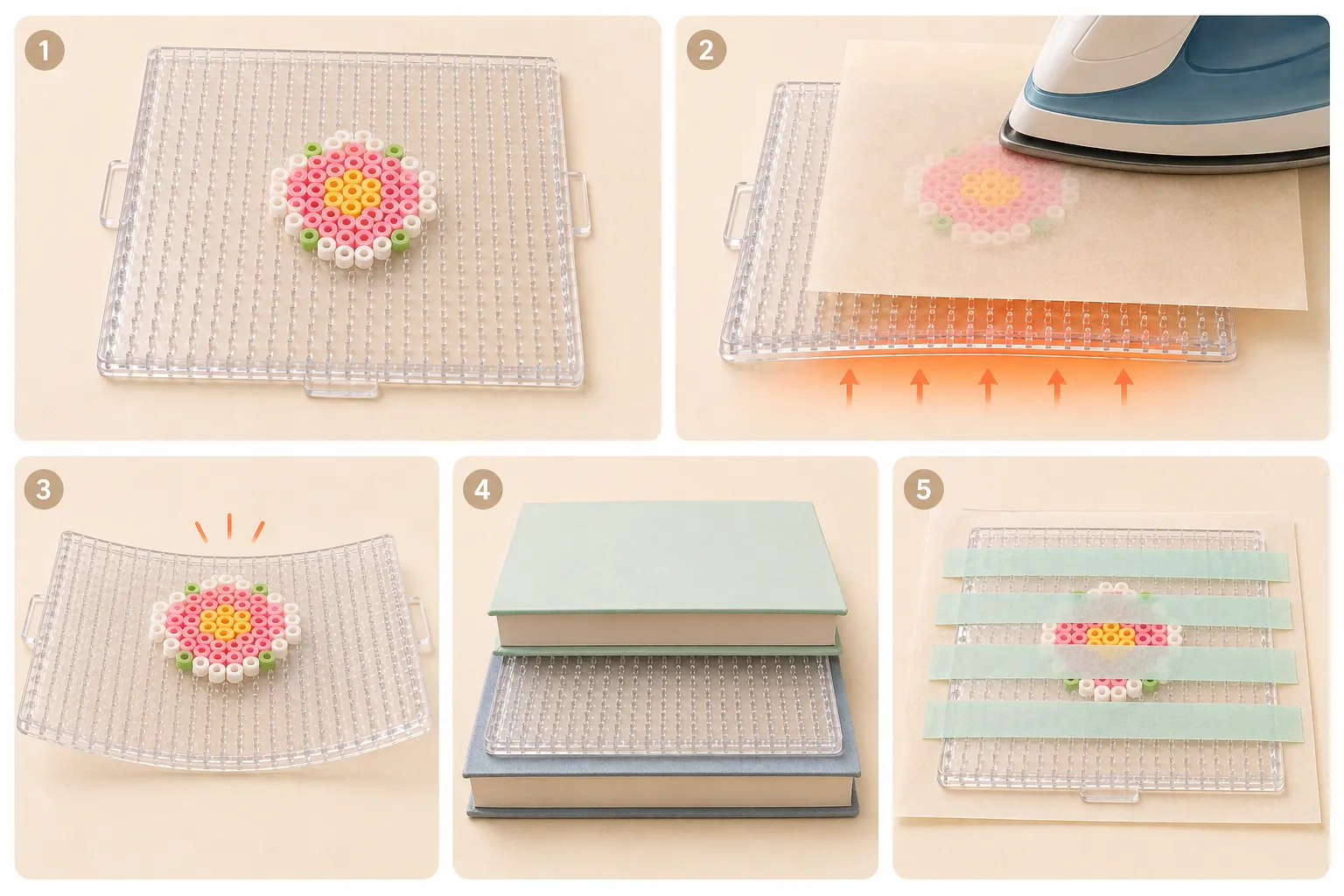
How to keep the next board from warping too
The core prevention idea is simple: do not let the board absorb long, repeated heat loads. Direct board ironing may survive small, light projects, but once your work gets larger, flatter, or more heat-intensive, the board eventually starts paying the price.
This is one reason many people move to the tape method as projects grow. It is not automatically more advanced in an abstract sense. It simply removes much of the heavy ironing burden from the board itself. That makes it a prevention upgrade, not a board-straightening trick.
- Do not park heavy heat in one zone for too long.
- The larger the project, the more seriously you should consider tape method.
- If you want boards to last, do not let every demanding piece finish on the board.
- As project complexity rises, the workflow often needs to mature too.
When switching to the tape method makes the most sense
If you are now building multi-board pieces, doing heavier flattening, frequently reheating, or have already warped multiple boards, that is usually a strong signal that the tape method is no longer optional for you.
Tape method is not mandatory for every tiny design, but it becomes a very practical upgrade once continuing to iron directly on the board clearly raises the risk of further damage.
- Multi-board projects: strong case for tape method.
- Repeated reheating: strong case for tape method.
- Multiple warped boards already: do not delay the workflow upgrade.
- Small pieces can stay flexible, but large pieces should not rely on hope.
- Tape method solves future heat exposure, not existing board deformation.
FAQ
Can I still use a slightly warped pegboard?
Sometimes yes, if beads still sit securely and alignment is stable. But it is safer to treat it as a practice board rather than trusting it for larger or more exact projects.
If the board is bulging, is it automatically ruined?
Not always instantly ruined, but once the bulge affects bead stability or alignment, it is no longer dependable for serious projects.
Does a warped pegboard always mean my temperature was too high?
Not necessarily. Long dwell time, repeated reheating, large-board ironing, and heavy flattening can also warp boards even when the temperature setting itself is not wildly extreme.
Can tape method straighten a warped pegboard?
No. Tape method keeps most future ironing heat off the board; it does not re-straighten a board that has already warped. If you try to salvage a mildly warped board, do it only on an empty board and treat any improvement as limited, not a factory reset.
When should I stop ironing directly on the board and switch to tape method?
If you are making larger pieces, reheating often, doing heavier flattening, or already warping multiple boards, that is usually the point where tape method becomes the safer long-term route.