Short answer
If you want a straightforward start in regular-size fuse beads, Perler or Hama are usually easier places to begin. If you already know you care about more size and material choice, Artkal is often the more flexible route. When in doubt, start with the system you can refill most easily and find the most matching tools and references for.
- The best first brand is usually the one you can keep buying and using consistently.
- Perler and Hama both offer mature regular-size routes that are easier for many beginners to understand.
- Artkal becomes especially attractive when you already know you want finer size or material options.
- The real decision is not the logo. It is the size system, refill convenience, and project fit.
You are choosing a system, not just a brand name
For beginners, brand choice is really system choice: bead size, pegboard compatibility, refill habits, tool pairing, pattern ecosystem, and what kind of projects you can keep making without friction.
So the first question is not who wins online arguments. It is whether you want a regular-size path first, whether you already know you want smaller beads, and whether refill and accessory convenience matter more than maximum option depth.
- Decide the size path before you obsess over brand loyalty.
- Think about refills and accessories, not just the first order.
- Match the brand route to the projects you actually want to make.
Who each brand tends to fit best
Perler is often one of the easiest routes for people who just want to start making regular fuse bead projects quickly. The official line includes regular and mini products, and the overall ecosystem is easy to understand.
Hama also offers a mature regular-size route, but its official size layering is very explicit: Original or Midi for the regular line, Mini for finer detail, and Maxi for younger beginners. That gives it a clear, traditional system feel.
Artkal is often strongest not because it is automatically simpler for everyone, but because it offers more detailed size and material branching. If you already know you care about those choices, it can be a very attractive path.
- Perler: strong for people who want a familiar, easy-entry regular route.
- Hama: strong for people who like a stable size-layered system.
- Artkal: strong for people who already want more branching in size or bead feel.
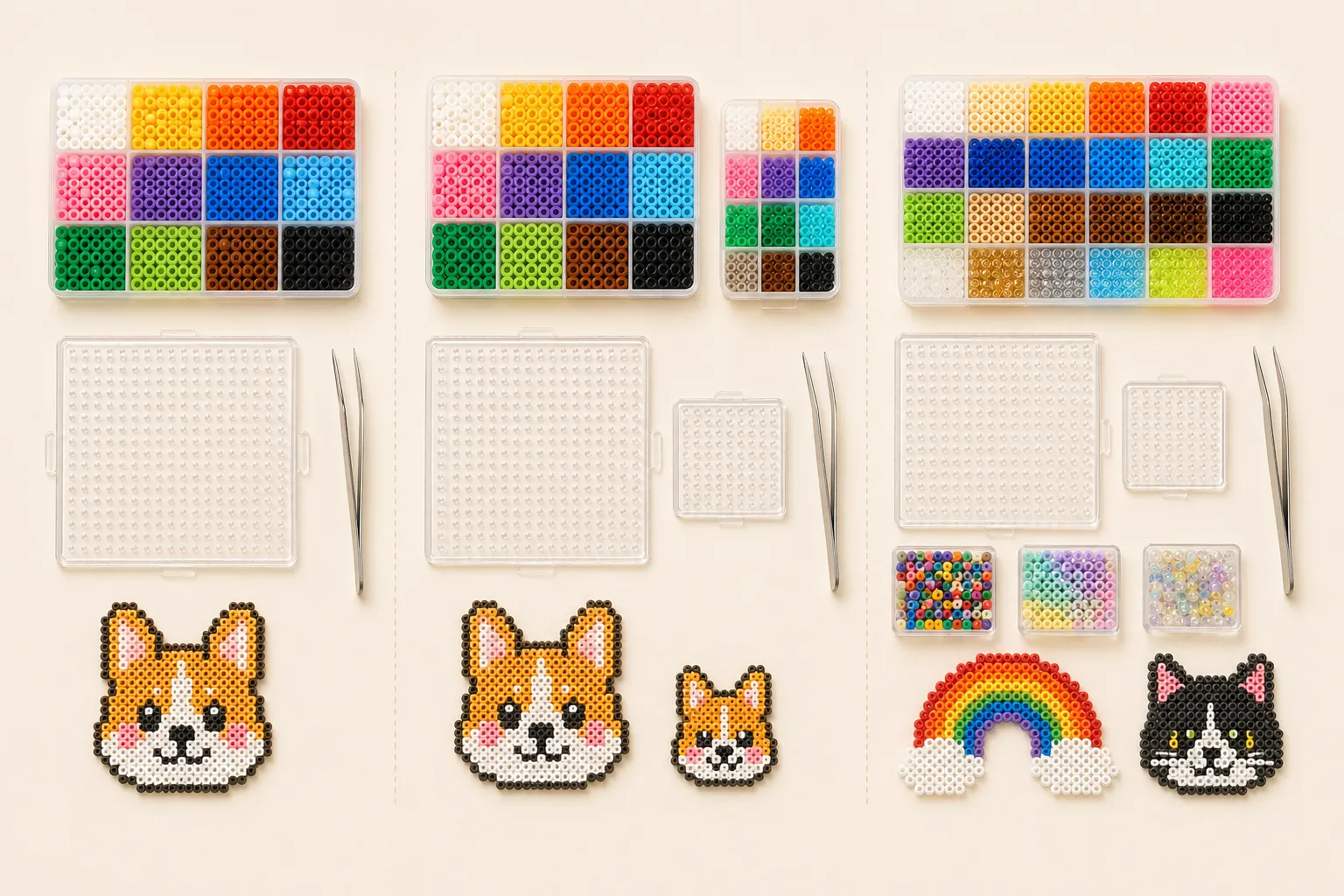
What is the safest first purchase for a beginner
If you do not yet know your size direction, the safest move is usually to start with a regular-size system rather than jumping immediately into a smaller, more demanding route. That gives you room to stabilize placement, flipping, ironing, and flattening before you add more complexity.
Another practical filter is refill reality. A technically great brand is not a great beginner brand for you if your common colors, boards, or matching accessories are a pain to replace.
- When unsure, start with a regular-size system first.
- Check whether your most-used colors are easy to rebuy individually.
- Check whether boards, paper, tweezers, and references are easy to match.
- A stable first system usually beats a theoretically perfect but messy one.
What beginners often overlook when buying the first set
Many people focus too hard on total color count, but the more important issues are whether the base colors are useful, whether the bead and board sizes match, whether single-color refills are easy, and whether your actual project types need that level of range.
If your first projects are small characters, charms, simple animals, or coasters, a stable regular-size route is often more useful than a more complex system that looks better only in theory. You can branch later when your needs are real.
- Do not only count colors; check whether the essential colors are practical.
- Do not mix size systems by accident.
- Think about refilling singles, not just opening the first kit.
- For most first purchases, stability matters more than prestige.
FAQ
Which is better for a total beginner, Perler or Hama?
If the goal is simply to start steadily in regular-size beads, both can work well. The more practical difference is usually which one is easier for you to buy, refill, and find compatible references and accessories for.
Is Artkal a bad first brand for beginners?
Not at all, but it tends to make the most sense when you already know you want more branching in size or material feel. If you are still learning the basics, a simpler regular-size route is often easier to stabilize first.
Should I buy the brand with the biggest color range first?
Not necessarily. For a first setup, clear sizing, useful base colors, and easy refills usually matter more than having the biggest theoretical palette right away.
If I might want mini beads later, should I start there now?
Only if you already know you genuinely prefer the finer workflow. Otherwise, it is usually safer to stabilize regular-size technique first and move into mini later on purpose.