Réponse courte
Choisis un motif avec un contour bien fermé et une vraie surface d’appui, repasse l’ensemble de manière régulière, puis prends le refroidissement et la mise à plat au sérieux. Le but n’est pas seulement qu’il soit joli, mais qu’il tienne stable.
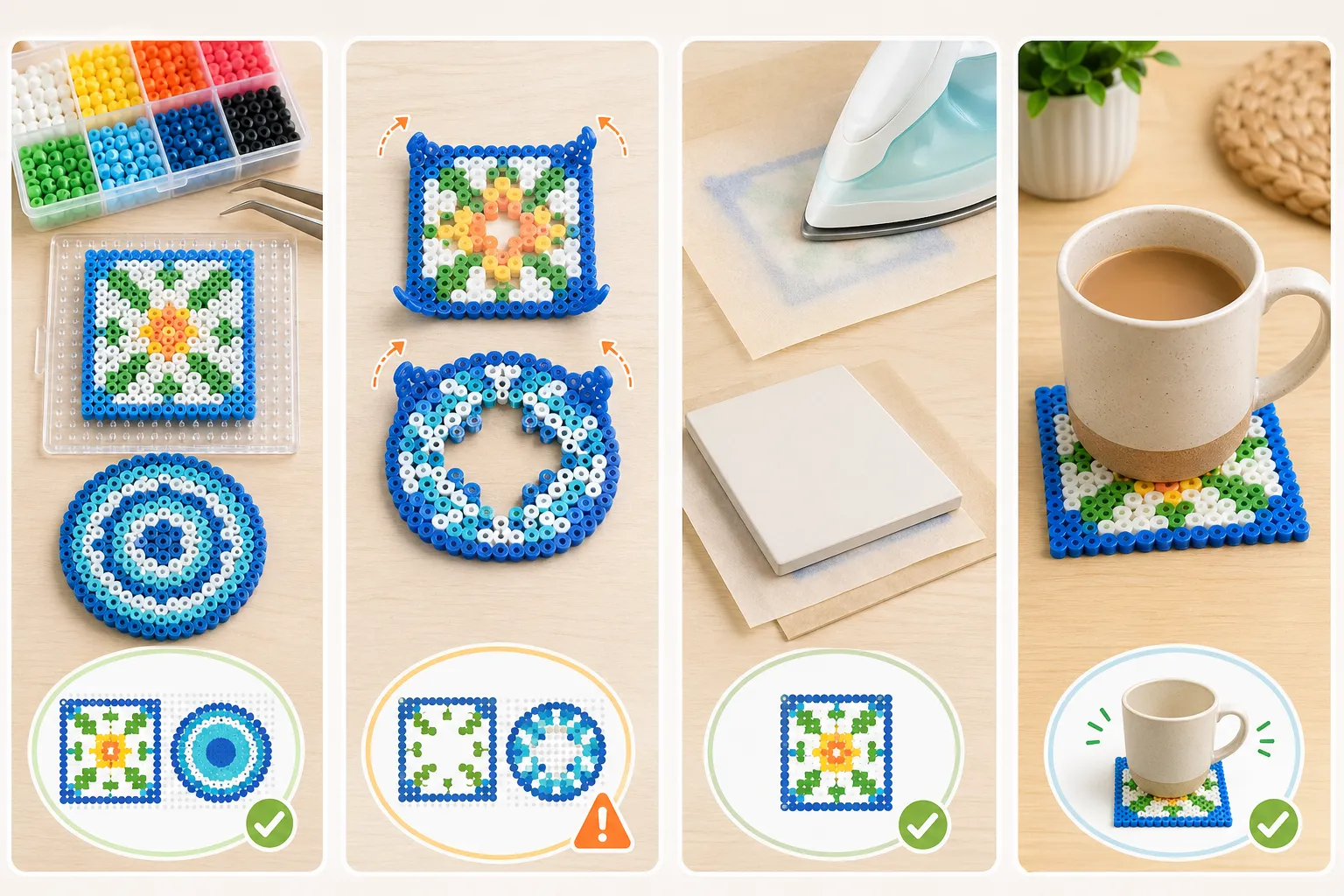
- Les dessous de verre supportent mal les centres bombés, les bords relevés et les motifs trop creux.
- Les motifs plus pleins sont souvent plus pratiques.
- La mise à plat compte encore plus ici que pour un petit charm.
- C’est un bon projet pour travailler une chauffe régulière plutôt que le détail extrême.
Pourquoi c’est un bon exercice de planéité
Because coasters are broad, flat pieces, they are excellent for learning how to heat a surface evenly and cool it flat. Any inconsistency across the piece shows up quickly in the final result.
This is the key difference from a keychain. A keychain mostly punishes weak connections. A coaster mostly punishes uneven surfaces.
Quels motifs fonctionnent mieux en dessous de verre
The strongest coaster patterns usually have a complete outline and a fairly solid footprint, such as simple portraits, badges, geometric motifs, and square or round bases. The more the piece feels like one coherent block, the easier it is to make practical.
A design with too many holes, jagged edges, or only a thin outer ring may look interesting but often feels less stable in actual use. A coaster does not have to be fully solid, but the main support area should not be too empty.
- Prefer complete outlines and more solid coverage.
- Avoid patterns with too many cutouts or tiny edge teeth at first.
- Round, square, and badge-like shapes are usually more stable than long irregular shapes.
- If you want a character design, a head or bust is often better than a thin full-body pose.
Le plus important : garder toute la surface cohérente
With coasters, the goal is not just getting every bead to bond. It is getting the whole surface close to the same state. If one region is clearly lighter or heavier than the rest, the piece often cools with noticeable unevenness.
Because coasters usually cover more area than a small charm, flattening cannot be an afterthought. Minor waves while warm often become more obvious after cooling.
- Do not focus only on the center and forget the perimeter.
- Short corrective passes are safer than one heavy pass.
- Cool the piece under pressure on a truly flat surface.
Ce qui rend vraiment la pièce pratique
If you want a coaster that actually gets used, think beyond the pattern itself. The contact area, balance, edge feel, and resistance to rocking all matter.
A fuse bead coaster makes more sense as a handmade surface protector for ordinary cups and mugs than as an industrial high-heat pad. That mindset leads to better project choices.
- Stability matters more than making the piece unusually thick.
- Practical gifts often benefit from simpler, more reliable shapes.
- Choose designs that are easy to set down and easy to wipe clean.
Les erreurs les plus courantes
- Forcing a fragmented full-body character into coaster duty.
- Chasing a nice-looking finish while ignoring surface consistency.
- Skipping real flattening during cooldown.
- Leaving the main support zone too hollow.