Réponse courte
Pour débuter, le plus sûr est de choisir un petit motif sur une seule plaque, d’éviter les pointes trop fines et les anneaux fragiles, puis d’ajouter les accessoires seulement après refroidissement. La structure passe avant le style.
- Un porte-clés pardonne moins qu’une pièce d’exposition quand la forme est trop fine.
- Le premier essai gagne à rester petit et stable.
- La zone autour de l’attache compte plus que le détail décoratif.
- Un objet porté tous les jours a souvent besoin d’une finition un peu plus solide.
Pourquoi le porte-clés est un bon premier projet fini
Keychains are small enough to give you fast feedback on the full workflow: pattern choice, placement, ironing, flattening, and final assembly. A mistake costs far less time than a large display piece.
At the same time, a keychain quickly reveals whether your structure is actually durable. A design that only barely survives the ironing stage can still fail once it starts moving around in daily use.
Quel type de motif choisir pour commencer
The best beginner keychain patterns are usually compact heads, badges, small animals, icons, and other shapes with a clear silhouette. The more the design depends on thin antennae, hair spikes, tiny weapons, or single-bead links, the more likely it is to fail later.
If a design only holds an important part together through one or two beads, reinforce it in the pattern stage first. Thickening or shortening a weak area is usually smarter than hoping the finished piece will somehow survive daily wear.
- Start with something that fits on one board comfortably.
- Prefer grouped shapes over many thin outward projections.
- Let the attachment area connect to a wider mass of beads.
- Use 5mm first unless you already have solid mini-bead control.
Les zones à surveiller pendant la fabrication
Do not judge the piece only by whether it fused overall. Check the loop area, top corners, bottom tips, and every thin projection because those are the places that usually take the most stress later.
If you want the piece itself to provide the hanging point, make sure that area is not just a fragile ring of beads. A safer route is often to keep the body strong first and let the hardware handle more of the stress.
- Decide early which edge or corner will carry the load.
- Very sharp corners can be softened slightly for better durability.
- Protect thin projections when flipping and flattening.
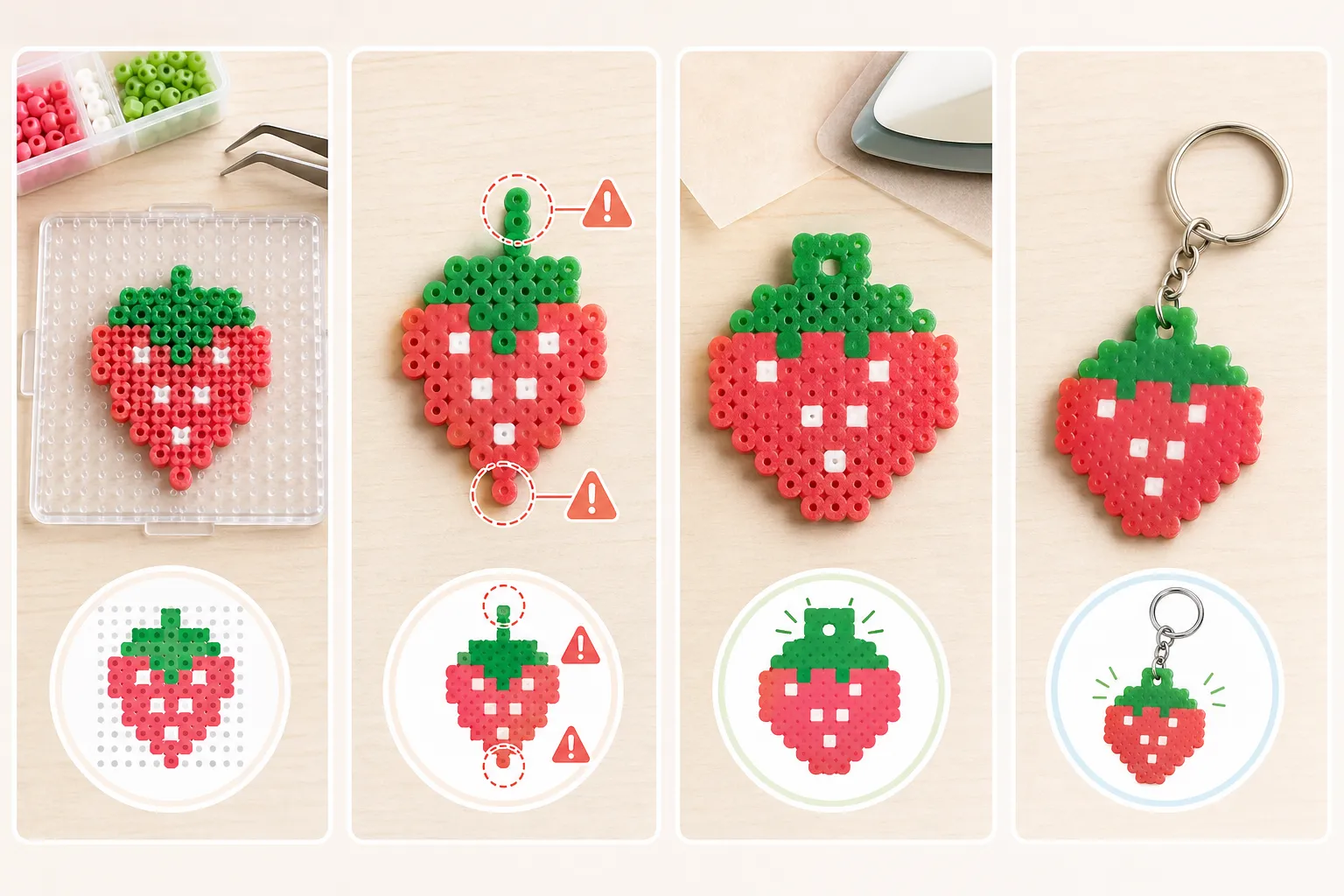
Comment penser l’anneau et la sangle
Assembly matters more than many beginners expect. Small keychains usually pair better with lighter rings, straps, or clips rather than a very heavy metal bundle that constantly pulls on one point.
If the piece is wide or has an off-center balance, think ahead about how it will hang. A stable piece can still feel awkward if it always twists or leans in use.
- Use lighter hardware for small pieces when possible.
- Check the balance on wide or long designs.
- Test with a gentle pull before daily use.
Les ratés les plus fréquents
- Choosing a design that is too large or too fragmented for a first try.
- Placing the hanging point on the thinnest edge.
- Ironing only for looks, not for real carrying strength.
- Adding heavy hardware that concentrates stress on a tiny area.