先に結論
初心者向けでいちばん安全なのは、1枚板に収まる小さめの図案を選び、細い突起や弱い輪っかを避けて、冷めてから金具を付けるやり方です。まずは可愛さより壊れにくさを優先しましょう。
- キーホルダーは飾り作品より細い突起に弱い。
- 最初の1個は大作より、小さくまとまった形のほうが成功しやすい。
- 負荷が集まるのは輪っか周辺なので、そこが一番大事。
- 毎日持ち歩く前提なら、見た目重視より少し丈夫寄りで考える。
なぜキーホルダーは最初の完成品に向いているのか
Keychains are small enough to give you fast feedback on the full workflow: pattern choice, placement, ironing, flattening, and final assembly. A mistake costs far less time than a large display piece.
At the same time, a keychain quickly reveals whether your structure is actually durable. A design that only barely survives the ironing stage can still fail once it starts moving around in daily use.
最初のキーホルダー図案は何を選ぶべきか
The best beginner keychain patterns are usually compact heads, badges, small animals, icons, and other shapes with a clear silhouette. The more the design depends on thin antennae, hair spikes, tiny weapons, or single-bead links, the more likely it is to fail later.
If a design only holds an important part together through one or two beads, reinforce it in the pattern stage first. Thickening or shortening a weak area is usually smarter than hoping the finished piece will somehow survive daily wear.
- Start with something that fits on one board comfortably.
- Prefer grouped shapes over many thin outward projections.
- Let the attachment area connect to a wider mass of beads.
- Use 5mm first unless you already have solid mini-bead control.
作るときに特に気を付けたい場所
Do not judge the piece only by whether it fused overall. Check the loop area, top corners, bottom tips, and every thin projection because those are the places that usually take the most stress later.
If you want the piece itself to provide the hanging point, make sure that area is not just a fragile ring of beads. A safer route is often to keep the body strong first and let the hardware handle more of the stress.
- Decide early which edge or corner will carry the load.
- Very sharp corners can be softened slightly for better durability.
- Protect thin projections when flipping and flattening.
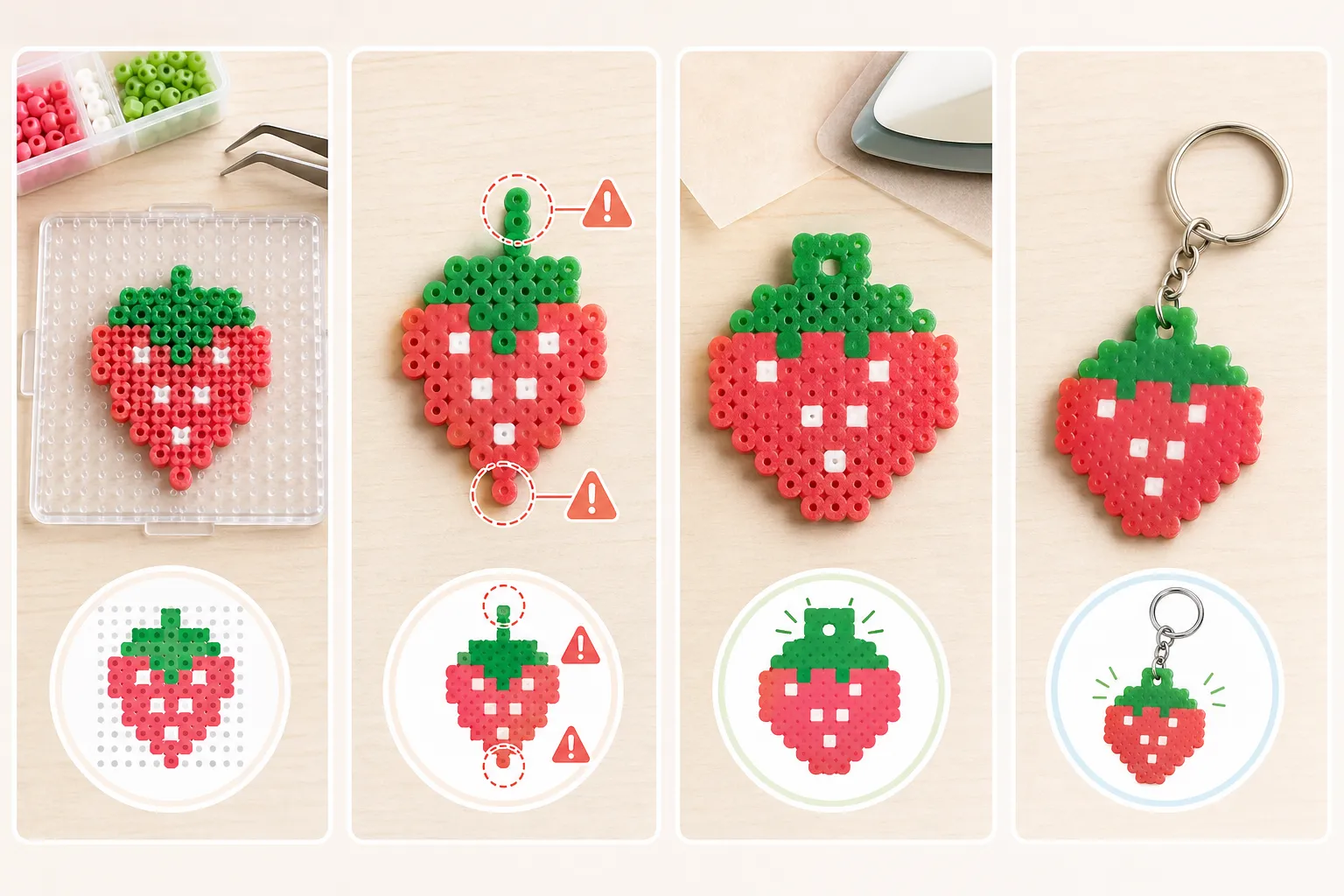
リングやストラップを無理なく付ける考え方
Assembly matters more than many beginners expect. Small keychains usually pair better with lighter rings, straps, or clips rather than a very heavy metal bundle that constantly pulls on one point.
If the piece is wide or has an off-center balance, think ahead about how it will hang. A stable piece can still feel awkward if it always twists or leans in use.
- Use lighter hardware for small pieces when possible.
- Check the balance on wide or long designs.
- Test with a gentle pull before daily use.
よくある失敗ポイント
- Choosing a design that is too large or too fragmented for a first try.
- Placing the hanging point on the thinnest edge.
- Ironing only for looks, not for real carrying strength.
- Adding heavy hardware that concentrates stress on a tiny area.