Short answer
The most important part of shading fuse bead art is not how many dark layers you use. It is where the light comes from, which planes stay bright, which planes turn away, and whether the shadow edges should feel sharp or soft. If the light direction is inconsistent, more colors usually just make the piece dirtier.
- Good shading starts with consistent light direction before color depth.
- If the major forms are unclear, adding more shadow fragments usually makes the piece messier.
- Highlights are not allowed everywhere, and shadows are not for filling empty space.
- Faces, hair, and clothing usually fail because the shading logic is not unified.
Unify where the light is coming from before each area starts doing its own thing
A lot of awkward shading is not caused by the wrong color. It is caused by inconsistent light direction. The face reads as if lit from the upper left, the hair reads from the right, and the clothing folds behave as if there is another light from below. Each area may look acceptable alone, but together the character falls apart.
Fuse bead art is especially unforgiving here because every bead is explicit. There is less room to hide inconsistent lighting inside painterly texture. Once the light direction breaks, the whole figure loses coherent volume.
- Choose the main light direction before placing shadows.
- Most major forms on the character should follow the same lighting language.
- A beautiful local shadow still feels false if it fights the whole-body light logic.
Build major form before broken-up shadow detail
One of the most common mistakes is jumping straight into tiny shadow fragments and little highlights because they feel more refined. But if the head, face, hair, and clothing masses still have no clear light side and dark side, those details only make the image busier.
Fuse bead art usually works better when the larger surfaces are stabilized first. Decide which side of the form is mostly facing light and which side is turning away, then decide whether local transitions are even necessary.
- Separate light planes and dark planes before worrying about texture.
- Major form must stand up before micro-shadow detail can help.
- Smaller shadows should sit on top of stable big-form logic.
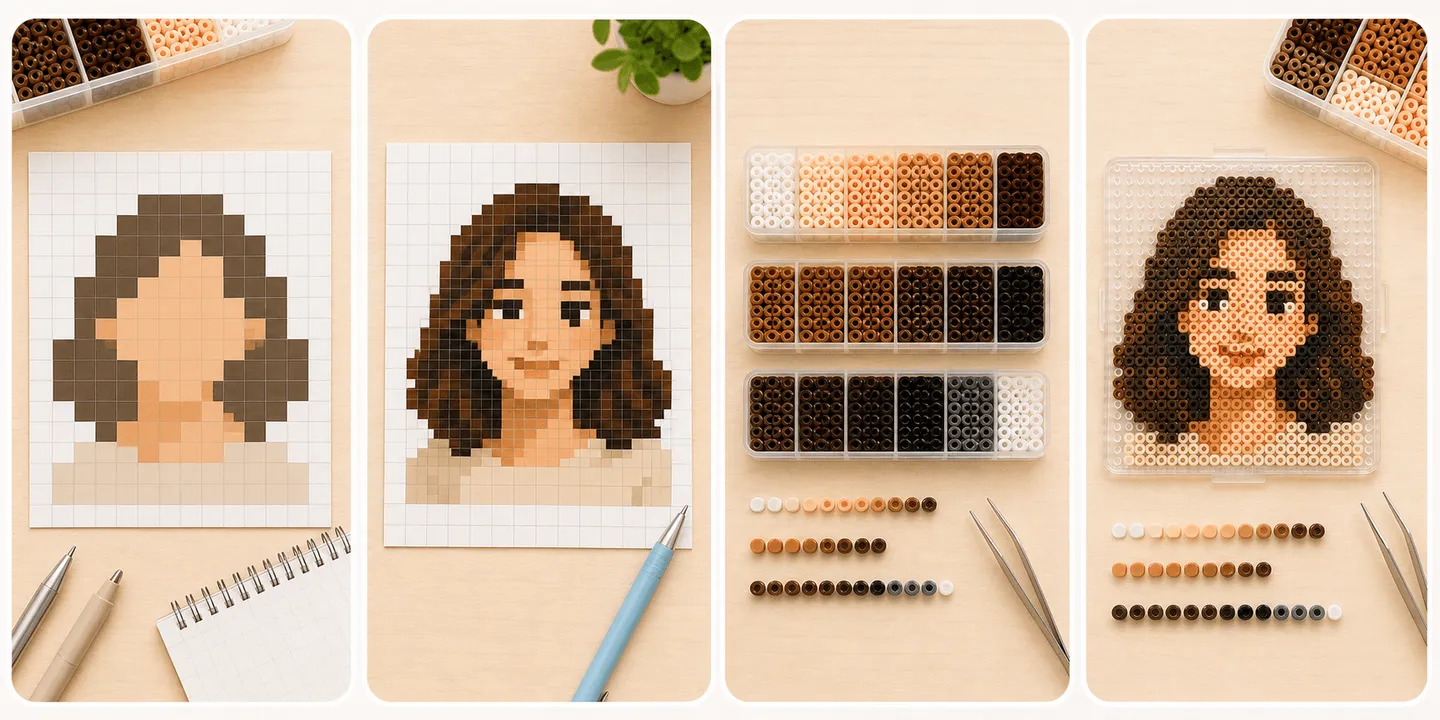
Where shadows should land if you want structure instead of dirty blocks
Useful shadows usually appear at turns, overlaps, recesses, and back-facing planes, not in random empty spaces. Hair covering part of the face, a collar sitting over the neck, a sleeve folding inward, or a chin dropping over the throat all create believable shadow opportunities.
When shadows appear without a structural reason, they quickly stop reading as volume information and start reading as dirty patches. In fuse bead shading, shadow placement needs a physical explanation.
- Prioritize turning planes, occlusion, and recessed forms.
- Dark color without structural reason often becomes mud.
- Shadows should explain volume, not just fill space.
When shadow edges should feel hard and when they should feel softer
Not every shadow edge should be treated the same way. Cast shadows, hair overlap, and collar shadows usually want more definite edges. Round cheeks, facial turning planes, and gentle fabric falloff usually want softer transitions.
If every edge is hard, the character gets sliced into pieces. If every edge is soft, everything turns gray and slack. Good shading often comes from knowing which edges should stay clear and which ones should relax.
- Occlusion and cast shadows often want harder edges.
- Round turning planes often want softer transitions.
- All-hard or all-soft edge behavior both weaken believable volume.
Why highlights often ruin a piece faster than shadows
A lot of designs are not failing because the darks are too weak. They fail because the highlights are too frequent, too fragmented, or too loud. Highlight areas are usually small, so when they multiply everywhere, the figure starts looking as if it is lit by several conflicting lamps.
The most useful highlights in fuse bead art are often the most restrained ones. Put them only where they truly sharpen the form, keep the area controlled, and make them obey the same lighting system as the shadows.
- Highlights are priority information, not decorative sparkles.
- The smaller the highlight, the more precise its position needs to be.
- If highlights appear everywhere, the whole shading structure collapses.
The most common shading failures in faces, hair, and clothing
Faces often fail when the nose bridge, under-eye area, cheek side, and chin do not agree on the same turning logic, so the features feel pasted on instead of built into one head. Hair often fails when every strand tries to get its own highlight and the whole mass disappears. Clothing often fails when fold shadows become so fragmented that the silhouette and wearing logic break apart.
All of these work better when you think in blocks before threads and patterns. If the larger surfaces are right, even reduced detail can still feel solid. If the larger surfaces are wrong, extra detail usually makes the piece look even more false.
- For faces, stabilize plane turns before micro-feature shadows.
- For hair, establish the whole light-dark mass before strand-level shine.
- For clothing, preserve the wearing logic before increasing wrinkle density.
FAQ
Does more shadow layering always make bead art look more advanced?
No. Extra layers only help when the light direction, forms, and edge logic are already coherent. Otherwise they usually just create more broken-up dark patches.
Why does my character look dirtier after I add shading?
Usually because the shadows are not landing on real turning or overlap structure, or because the major form was never separated clearly before small dark fragments were added.
Which is easier to ruin, highlights or shadows?
Often highlights. They are small but visually loud, so once they are misplaced they immediately break the light logic and the volume read.
What should I practice first if I want better shading?
Usually consistent light direction and a clear light-mid-dark form split. That teaches more than jumping straight into lots of tiny rendering details.