先に結論
ビーズがくっつかないときは、まず温度、当てる時間、アイロンの動き、そしてその部分の構造の弱さを順番に確認します。多くの場合、足りないのは力ではなく、熱の届き方です。
- 最初に見るべきは圧力より、熱と時間。
- 端、角、細い接続は中央より失敗しやすい。
- アイロンの問題に見えて、実は図の弱さが原因なことも多い。
まずどのタイプの「くっつかない」かを分ける
Not every “not fusing” problem is the same. Sometimes the whole piece feels loose. Sometimes only the edges open up. Sometimes thin parts break after a flip. Sometimes the piece seems fine while warm, then small areas split after cooling.
That distinction matters because a loose overall piece usually points to incomplete heat coverage, while a failure isolated to edges, tips, or thin parts often points more strongly to local heat gaps or fragile structure.
- Whole piece loose: check heat, time, and coverage first.
- Only edges loose: check edge coverage and iron path.
- Only thin parts failing: check structural strength first.
- Cracks after cooling: check whether the real bond depth was too shallow.
よくある 4 つの原因
The first cause is insufficient temperature. The second is enough temperature in theory, but not enough time to form a real bond. The third is moving too fast, so the heat passes over the area without staying long enough. The fourth is that barrier material, weak edges, or the design structure make the weakness more visible.
Beginners often assume that many passes automatically mean enough ironing, but repeated fast passes can still leave real fusion shallow, especially near the outer edges.
- Temperature too low: beads soften but do not really lock together.
- Time too short: the surface changes before the bond gets deep enough.
- Movement too fast: heat is present but never settles long enough.
- Structure too weak: even a partial bond can split during movement or cooling.
いちばん手間の少ない見直し順
Start by checking where the weakness appears. If the loose sections are mainly on edges, corners, or one-bead-wide joins, the problem is often local rather than global. That means the smartest first fix is usually not a full aggressive re-iron.
If the entire piece feels loose, then move back to overall heat and dwell time. If only one area keeps reopening, a local repair, a better iron path, or even a pattern change is usually more effective than redoing the whole surface the same way again.
- First locate whether the weakness is global or local.
- Global looseness: correct heat coverage first.
- Local looseness: patch locally before redoing everything.
- Repeating failures in the same thin area usually point to structure.
さらに悪化させずに直す方法
If the whole piece is a little loose, the safest repair is usually another even pass with proper barrier material and more intentional coverage, not crushing one spot with force. That lowers the chance of over-melting one zone while the rest still stays under-fused.
If the weakness is only on an edge, corner, or thin part, a local repair is often better. Keep the movement controlled and resist parking the iron too violently in one place. If the join itself is only one bead wide, a heat repair may still have limited success because the structure is the deeper issue.
- Whole piece loose: redo coverage more evenly.
- Only one area loose: try a local repair before a full re-iron.
- Thin repeated failures: consider widening or reshaping the pattern.
- The goal is a stable bond with preserved outline, not the flattest finish possible.
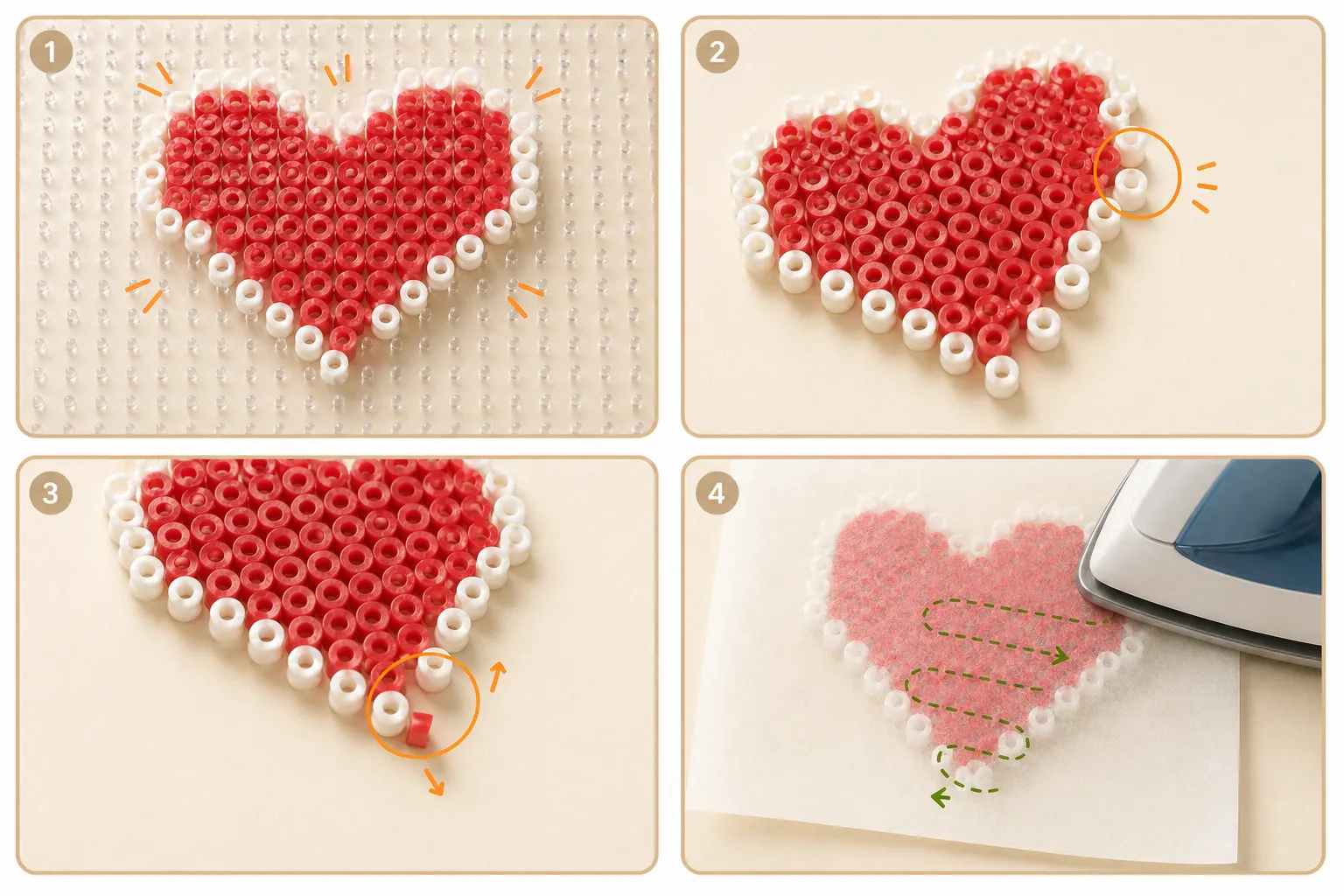
同じ失敗を次で減らすには
The best prevention is not memorizing a fixed number of seconds. It is learning to watch coverage and structure at the same time: whether edges are getting equal attention, whether the barrier material is letting the bond develop evenly, and whether the thin parts were a bad structural bet from the start.
Project choice matters too. If your earliest builds are full of thin weapons, hair spikes, sharp corners, and one-bead links, the piece will naturally feel less forgiving even when your technique is not terrible.
- Choose more stable beginner projects and patterns first.
- Do not focus only on the center while ignoring edges and tips.
- Many fast passes are not the same as enough real heat coverage.
- When the same area always fails, change the design instead of only blaming the iron.