Kurzantwort
Am sichersten ist ein kompaktes Motiv, eine stabile Rückseite für die Auflage und eine Magnetplatzierung, die zur Breite und zum Gewicht des Stücks passt. Je breiter das Motiv, desto weniger sollte ein einziger kleiner Magnetpunkt alles tragen müssen.
- Schwierig ist nicht nur das Frontmotiv, sondern vor allem Rückseite und Magnetlayout.
- Breitere oder höhere Formen verlangen mehr Blick auf die Balance.
- Eine unruhige Rückseite macht den Magneten trotz starker Kraft unsicher.
- Schön aussehen und gut haften sind zwei verschiedene Dinge.
Warum Magnete anders gedacht werden als Anhänger
Keychains mainly deal with hanging stress. Magnets deal with surface contact and balance. That means the biggest failure is often not breakage but poor adhesion, rocking, or hanging at an awkward angle.
Because of that, it helps to think about the magnet support plan from the beginning instead of treating it as a last-minute add-on.
Welche Vorlagen bessere Magnete ergeben
The safest magnet patterns are usually compact shapes with a reasonably complete back contact area, such as small portraits, badges, food icons, or simple animal faces.
If the design is visually heavier on one side, you should plan for that in the support layout. Otherwise the finished piece may keep twisting or leaning when attached.
- Start with compact shapes, not many long projections.
- Wider designs often need more than one support point.
- A more complete back contact area usually leads to a steadier magnet.
Warum die Rückseite so entscheidend ist
A magnet only feels dependable when the back surface gives it a stable contact area. If the back is highly uneven or only a tiny portion actually meets the metal surface well, the piece is more likely to wobble or rotate.
That does not mean every magnet must be aggressively full-melted, but the support area does need to be stable enough for the hardware choice.
- Decide where the support will sit, then inspect that area closely.
- If the back is too uneven, stronger magnets alone may not fix the feel.
- Attach the magnet only after the piece is fully cooled and set.
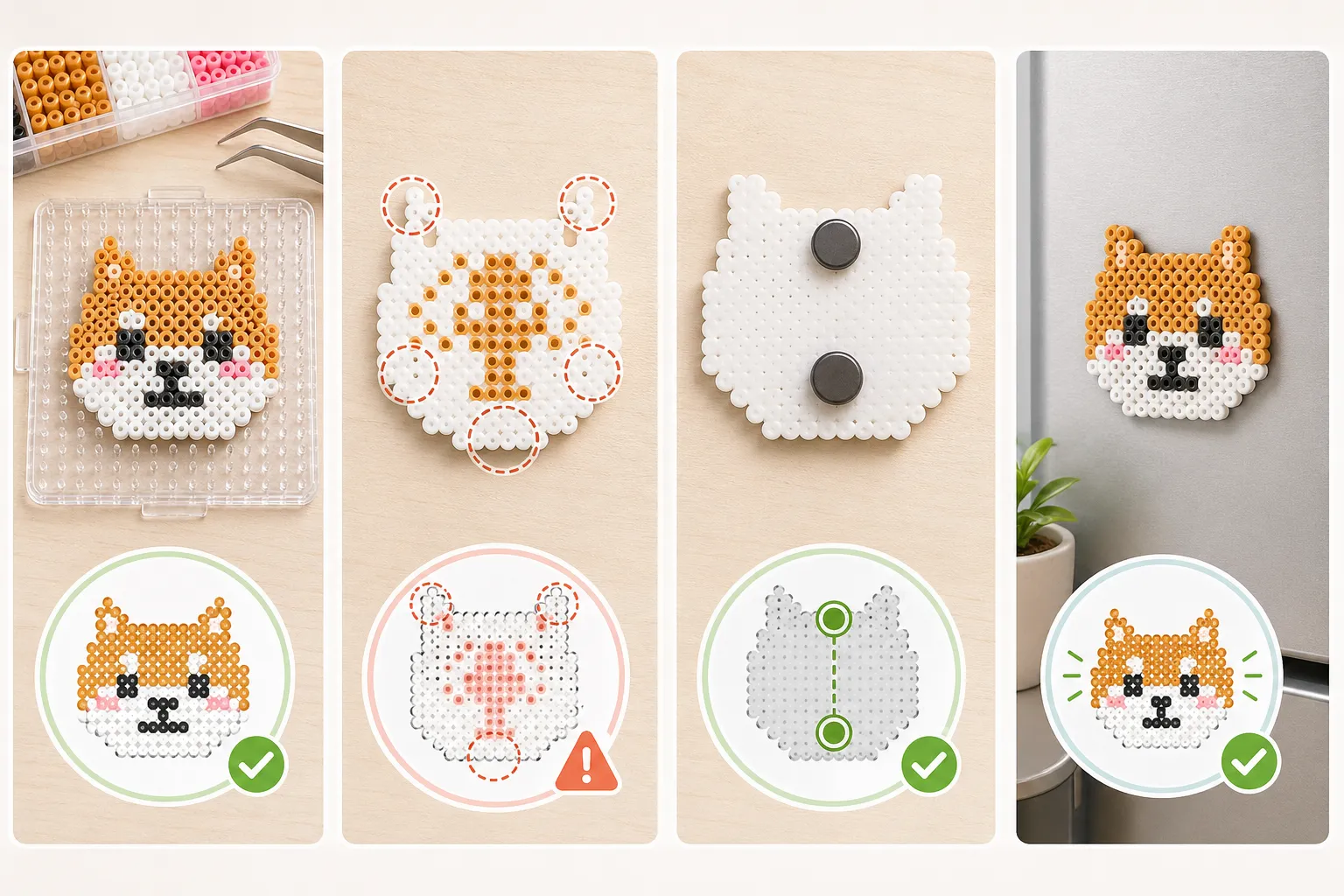
Wie du die Magnetposition planst
A tiny compact piece may work with one support point, but once the design becomes wider, taller, or obviously off-center, a broader support layout makes more sense. Matching support placement to visual weight improves how the piece sits.
After assembly, do not only check whether it sticks. Check whether it keeps twisting easily, sags to one side, or returns to an awkward angle. That usually signals a layout problem, not just a strength problem.
Typische Fehler
- Waiting until the end to think about magnet placement.
- Using one tiny support point for a broad piece.
- Attaching support to a back surface that is too uneven.
- Focusing only on front detail and ignoring the load path.