先に結論
まずは小さくまとまった図案を選び、磁石を置く裏面を安定させてから、作品の幅と重心に合わせて支え方を決めるのが安全です。横に広い図ほど、磁石1点で無理に支えないほうが安定します。
- 難しいのは表の可愛さより、裏面と磁石の配置。
- 横に広い形や背の高い形ほど重心を先に考える。
- 裏面が凸凹だと、磁石が強くても安定しにくい。
- 見た目が良いことと、貼り付きが良いことは別。
なぜマグネットはキーホルダーと考え方が違うのか
Keychains mainly deal with hanging stress. Magnets deal with surface contact and balance. That means the biggest failure is often not breakage but poor adhesion, rocking, or hanging at an awkward angle.
Because of that, it helps to think about the magnet support plan from the beginning instead of treating it as a last-minute add-on.
マグネット向きの図案はどんなものか
The safest magnet patterns are usually compact shapes with a reasonably complete back contact area, such as small portraits, badges, food icons, or simple animal faces.
If the design is visually heavier on one side, you should plan for that in the support layout. Otherwise the finished piece may keep twisting or leaning when attached.
- Start with compact shapes, not many long projections.
- Wider designs often need more than one support point.
- A more complete back contact area usually leads to a steadier magnet.
裏面がそこまで重要な理由
A magnet only feels dependable when the back surface gives it a stable contact area. If the back is highly uneven or only a tiny portion actually meets the metal surface well, the piece is more likely to wobble or rotate.
That does not mean every magnet must be aggressively full-melted, but the support area does need to be stable enough for the hardware choice.
- Decide where the support will sit, then inspect that area closely.
- If the back is too uneven, stronger magnets alone may not fix the feel.
- Attach the magnet only after the piece is fully cooled and set.
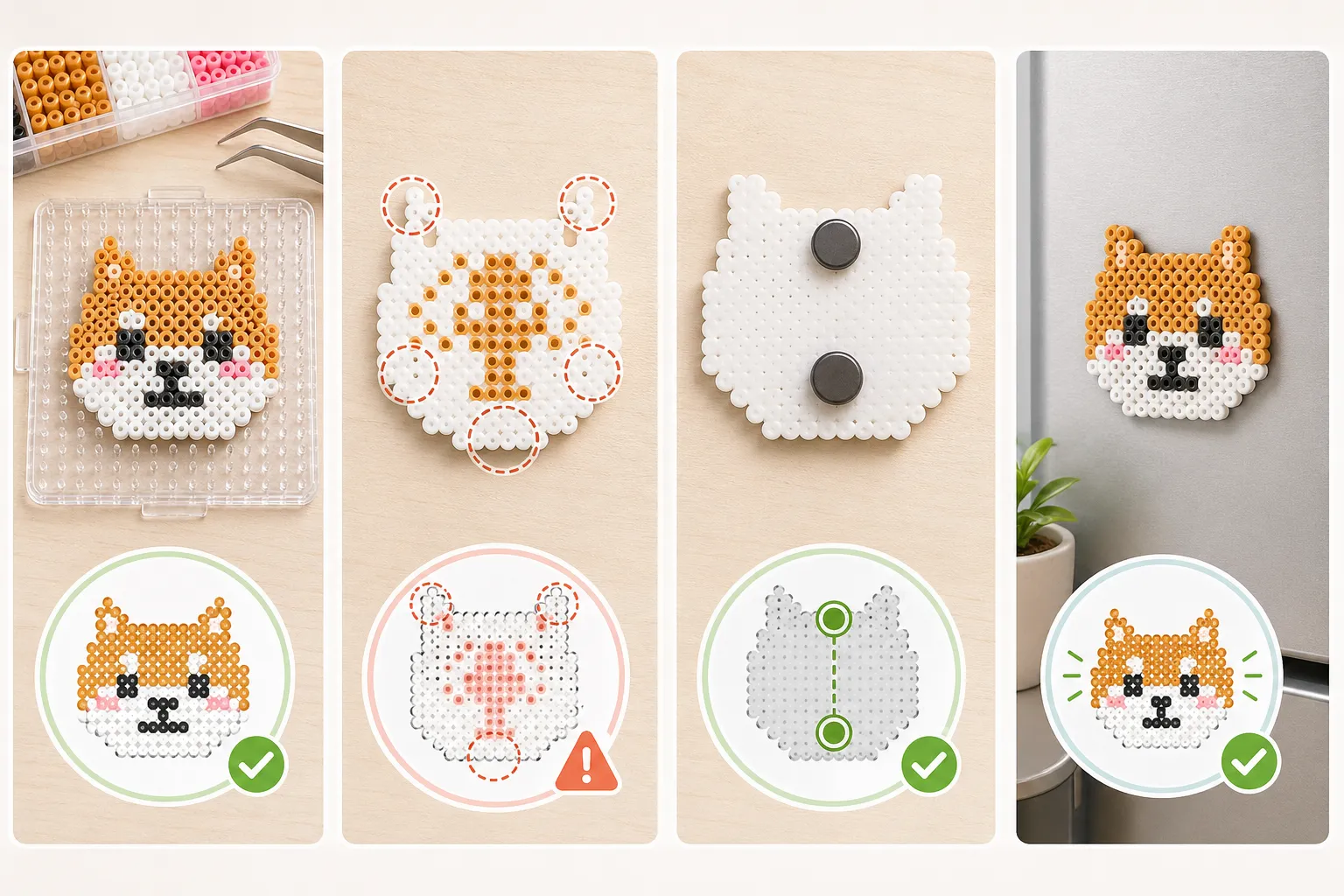
磁石の位置をどう考えるか
A tiny compact piece may work with one support point, but once the design becomes wider, taller, or obviously off-center, a broader support layout makes more sense. Matching support placement to visual weight improves how the piece sits.
After assembly, do not only check whether it sticks. Check whether it keeps twisting easily, sags to one side, or returns to an awkward angle. That usually signals a layout problem, not just a strength problem.
ありがちな失敗
- Waiting until the end to think about magnet placement.
- Using one tiny support point for a broad piece.
- Attaching support to a back surface that is too uneven.
- Focusing only on front detail and ignoring the load path.