Réponse courte
Le plus sûr est de partir sur un motif compact, de stabiliser la zone arrière qui recevra l’aimant, puis de répartir le soutien selon la largeur et le poids visuel de la pièce. Plus le motif est large, moins un seul petit point d’aimantation suffit.
- Le vrai sujet, ce n’est pas seulement le motif avant, mais le dos et la répartition des aimants.
- Les formes larges ou hautes demandent plus d’attention à l’équilibre.
- Un dos irrégulier réduit la stabilité même avec un aimant puissant.
- Une pièce jolie n’est pas forcément une pièce qui tient bien.
Pourquoi un magnet ne se pense pas comme un porte-clés
Keychains mainly deal with hanging stress. Magnets deal with surface contact and balance. That means the biggest failure is often not breakage but poor adhesion, rocking, or hanging at an awkward angle.
Because of that, it helps to think about the magnet support plan from the beginning instead of treating it as a last-minute add-on.
Quels motifs font de meilleurs magnets
The safest magnet patterns are usually compact shapes with a reasonably complete back contact area, such as small portraits, badges, food icons, or simple animal faces.
If the design is visually heavier on one side, you should plan for that in the support layout. Otherwise the finished piece may keep twisting or leaning when attached.
- Start with compact shapes, not many long projections.
- Wider designs often need more than one support point.
- A more complete back contact area usually leads to a steadier magnet.
Pourquoi le dos compte autant
A magnet only feels dependable when the back surface gives it a stable contact area. If the back is highly uneven or only a tiny portion actually meets the metal surface well, the piece is more likely to wobble or rotate.
That does not mean every magnet must be aggressively full-melted, but the support area does need to be stable enough for the hardware choice.
- Decide where the support will sit, then inspect that area closely.
- If the back is too uneven, stronger magnets alone may not fix the feel.
- Attach the magnet only after the piece is fully cooled and set.
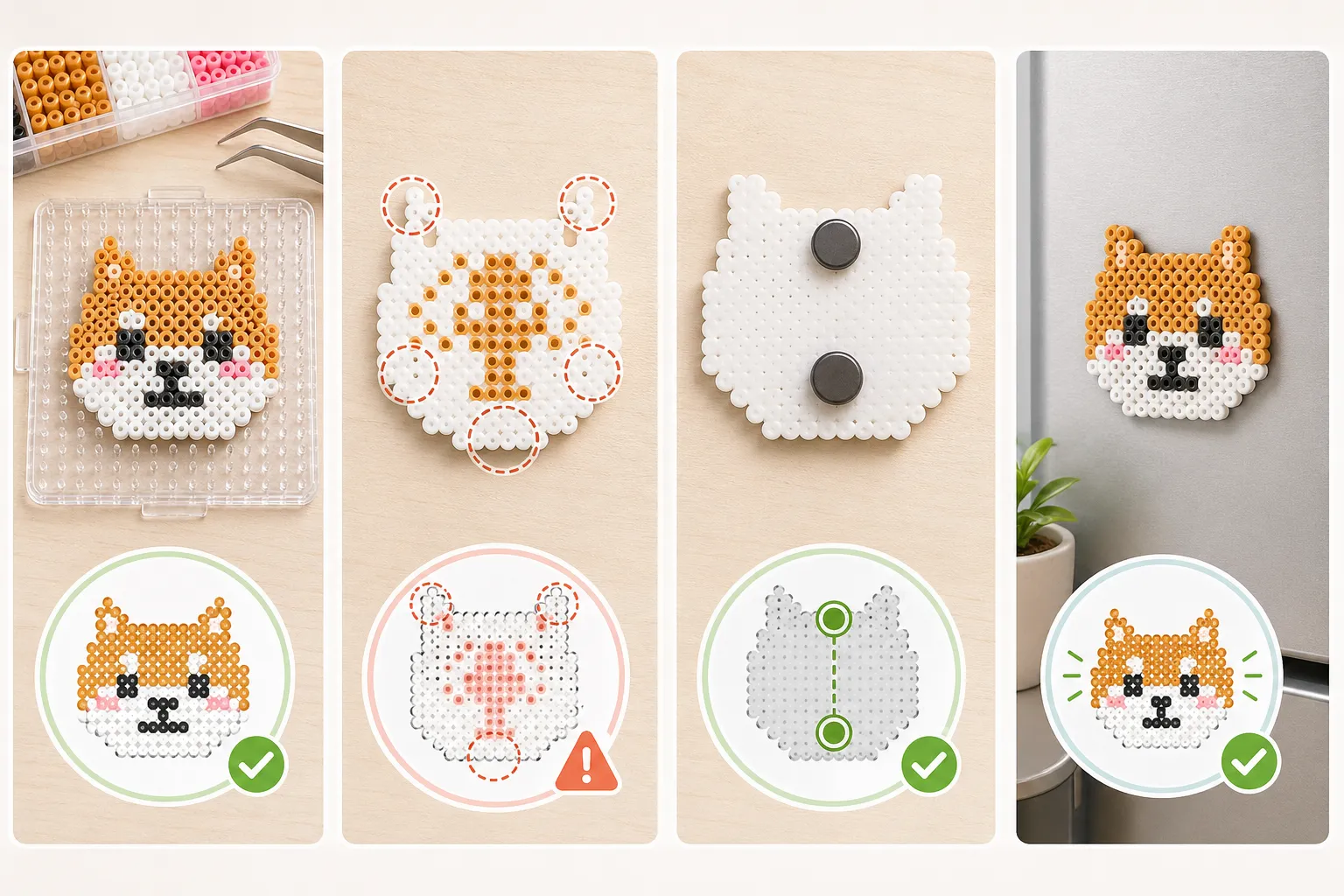
Comment réfléchir au placement des aimants
A tiny compact piece may work with one support point, but once the design becomes wider, taller, or obviously off-center, a broader support layout makes more sense. Matching support placement to visual weight improves how the piece sits.
After assembly, do not only check whether it sticks. Check whether it keeps twisting easily, sags to one side, or returns to an awkward angle. That usually signals a layout problem, not just a strength problem.
Les erreurs les plus courantes
- Waiting until the end to think about magnet placement.
- Using one tiny support point for a broad piece.
- Attaching support to a back surface that is too uneven.
- Focusing only on front detail and ignoring the load path.