짧은 답
작고 컴팩트한 도안을 먼저 고르고, 자석이 닿을 뒷면을 안정시킨 뒤, 작품의 크기와 무게중심에 맞춰 지지 방식을 정하는 편이 안전합니다. 가로로 넓은 작품일수록 자석 한 점에만 기대지 않는 게 좋습니다.
- 핵심은 앞면 디테일보다 뒷면과 자석 배치다.
- 넓거나 키 큰 모양일수록 무게중심을 먼저 생각해야 한다.
- 뒷면이 울퉁불퉁하면 자석이 강해도 안정감이 떨어진다.
- 예쁜 모양과 잘 붙는 구조는 같은 문제가 아니다.
왜 자석은 키링과 다른 사고방식이 필요한가
Keychains mainly deal with hanging stress. Magnets deal with surface contact and balance. That means the biggest failure is often not breakage but poor adhesion, rocking, or hanging at an awkward angle.
Because of that, it helps to think about the magnet support plan from the beginning instead of treating it as a last-minute add-on.
자석에 더 잘 맞는 도안은 어떤 것인가
The safest magnet patterns are usually compact shapes with a reasonably complete back contact area, such as small portraits, badges, food icons, or simple animal faces.
If the design is visually heavier on one side, you should plan for that in the support layout. Otherwise the finished piece may keep twisting or leaning when attached.
- Start with compact shapes, not many long projections.
- Wider designs often need more than one support point.
- A more complete back contact area usually leads to a steadier magnet.
왜 뒷면이 그렇게 중요한가
A magnet only feels dependable when the back surface gives it a stable contact area. If the back is highly uneven or only a tiny portion actually meets the metal surface well, the piece is more likely to wobble or rotate.
That does not mean every magnet must be aggressively full-melted, but the support area does need to be stable enough for the hardware choice.
- Decide where the support will sit, then inspect that area closely.
- If the back is too uneven, stronger magnets alone may not fix the feel.
- Attach the magnet only after the piece is fully cooled and set.
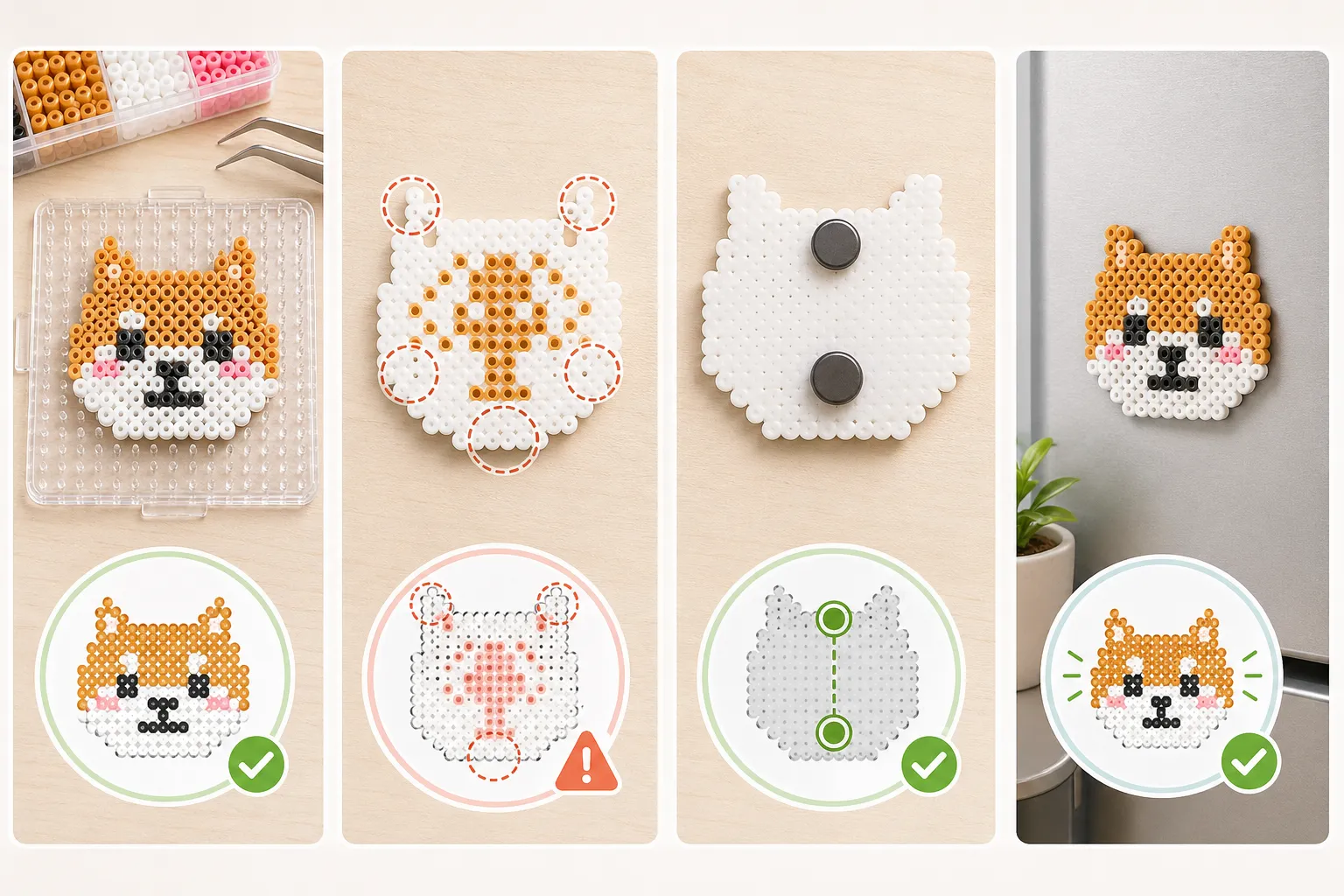
자석 위치를 어떻게 생각해야 하나
A tiny compact piece may work with one support point, but once the design becomes wider, taller, or obviously off-center, a broader support layout makes more sense. Matching support placement to visual weight improves how the piece sits.
After assembly, do not only check whether it sticks. Check whether it keeps twisting easily, sags to one side, or returns to an awkward angle. That usually signals a layout problem, not just a strength problem.
흔한 실수
- Waiting until the end to think about magnet placement.
- Using one tiny support point for a broad piece.
- Attaching support to a back surface that is too uneven.
- Focusing only on front detail and ignoring the load path.